Sailing Magazine

by Richard Crockett
The fleet swelled to a record nine yachts, with ‘Sunmaid’, ‘Yvette’ and ‘Tarpon’ not being entered despite being previous winners. Two new yachts came into the fray – being ‘Mariquita’ and ‘Tintomara’, with ‘Avocet’ and ‘Rapid’ returning for another shot at lifting the Lipton Cup.
‘Mariquita’ was a Arvid Laurin design, built in 1958, making her the newest in the fleet. ‘Tintomara’ was a Harry Becker design and built in 1955.
Besides new boats, there were new skippers and Clubs competing too. Zwartkops Yacht Club was challenging for the very first time, with Graham Packer sailing ‘Tintomara’, as was the Island Sailing Club with ‘Avocet’ and Dr Elsdon-Dew as skipper, although this was his second challenge.
John Sully was a new skipper sailing ‘Inger’ for the Bluff Yacht Club.

Race 1
This was set over a quadrilateral course anti-clockwise, with just two to three knots of wind coming in from the north-east. ‘Vanja V’ (PYC), ‘Mariquita’ (RNYC), and ‘Inger’ (BYC) chose the leeward end of the line, ‘Sun Rose’ (HSC) the middle, and the remainder at or near the weather end.
‘Sun Rose’ was the only boat to anticipate the strong southerly tide and current set, and persisted on a more weatherly course – the remainder of the fleet were set so far to leeward that they eventually failed to lay the first mark. ‘Sun Rose’, which might at one time have been assessed as lying about fifth, actually rounded this mark first, with ‘Tintomara’ (ZYC) close on her weather quarter.
The breeze freshened to approximately eight knots, and the order round this first mark proved to be the final order, except for the phenomenal finish between ‘Sun Rose’ and ‘Tintomara’, judged as being only two feet in favour of the latter after four hours of sailing in a fading breeze. These two boats exchanged the lead almost to the movement of the sea over the last few hundred yards, and ‘Tintomara’s’ larger spinnaker was probably the deciding factor in the race which lasted three hours, 46 minutes and 27 seconds.
‘Sun Rose’ led at every single mark except at the finish line.
Race 2
This was on the triangular course with clockwise roundings, in a light S.S.W. breeze of about four to five knots at the start, freshening to eight knots halfway on the second leg and about 12 knots on the second mark.
A start off the wind made a beautiful sight, with the display of coloured spinnakers on a port run. ‘Inger’ (BYC) luffed inshore and kept a wind-free run with ‘Mariquita’ (RNYC) faring second best.
‘Inger’ rounded the first mark in the lead, followed by ‘Mariquita’, third was ‘Rapid’ (RCYC) a few feet ahead of ‘Sun Rose’ (HSC) followed by ‘Trickson II’, ‘Tintomara’, ‘Vanja V’, ‘Sea Swallow’, ‘Avocet’.
On the close-hauled second leg, first ‘Sun Rose’ broke through ‘Rapid’s’ lee and ‘Mariquita’, similarly, through ‘Inger’. With the freshening breeze ‘Mariquita’ sped ahead and, ‘Sun Rose’ and ‘Tintomara’, sailing abreast foot for foot, slowly closed on ‘Inger’ – while the remainder were left astern.
After rounding the second mark in this order – ‘Mariquita’, ‘Inger’, ‘Sun Rose’, ‘Tintomara’, ‘Rapid’, ‘Vanja V’, ‘Trickson II’, ‘Sea Swallow’, ‘Avocet’ – the fleet sped for home on a close reach.
‘Sun Rose’ slowly worked through ‘Inger’s’ lee, while ‘Tintomara’ lost a little ground. However, the new risk was ‘Rapid’, now travelling very fast first through ‘Tintomara’ and then ‘Inger’, but just failing to catch ‘Sun Rose’ so that in another close finish the final positions were: ‘Mariquita’, ‘Sun Rose’, ‘Rapid’, ‘Inger’, ‘Tintomara’, ‘Vanja V’, ‘Trickson II’, ‘Sea Swallow’, ‘Avocet’.
Race 3
The start of the third race on the windward/leeward course was postponed for 30 minutes. The start was in still, airless conditions, but after some 10 minutes drifting a light northeast breeze filled in and the three most leeward boats, ‘Vanja V’, ‘Tintomara’, and ‘Trickson II’, picked up first and set off on a long starboard tack up the beach followed by ‘Sun Rose’ and ‘Mariquita’.
The remainder took a leg to seaward before coming back on to the starboard tack, their battle thereafter against the stronger southerly current left them far behind the inshore boats, though ‘Inger’ recovered well towards the end of the six-mile leg to windward.
The leading boats inshore commenced a most interesting tacking display up the coast line between Beachwood and Umhlanga, with ‘Mariquita’ working her way up from fourth to first place at the mark. ‘Sun Rose’, too, picked up by passing ‘Vanja V’ and ‘Trickson II’ in the last two tacks to the weather mark, where the breeze was now about eight to 10 knots.
The order round was ‘Mariquita’, ‘Tintomara’, ‘Sun Rose’, ‘Vanja V’, ‘Trickson II’, ‘Inger’.
On the long run home ‘Mariquita’ increased her lead to an easy first place. John Sully brought ‘Inger’ right through to second place, just beating ‘Tintomara’ to a very close finish for second place, with ‘Sun Rose’ close on ‘Tintomara’s’ heels.
The remaining order was unchanged, except for ‘Trickson II’ passing ‘Vanja V’ and involving ‘Sun Rose’ in her second two-foot margin at the finish; though contrary to the first race, in ‘Sun Rose’s’ favour this time.
Race 4
The course set for the fourth race was again out and home, though this time with a freshening south-west wind of about 25 – 28 knots at the start. The run to Umhlanga of six miles was finished in the phenomenal time of 40 minutes, running down the growing seas in a series of thrilling surges. With spinnakers set to port, ‘Trickson II’ stood more inshore than the remainder before gybing. She, with ‘Inger’, stood slightly too far to seaward of the leeward mark, and had some difficulty in executing two more gybes to round the mark in what were then big seas – ‘Trickson II’ split her mast soon after starting the windward leg, and retired.
Soon after the start most boats had difficulty in getting going on the run – ‘Tintomara’s’ spinnaker tore in half; ‘Sun Rose’ nearly broached and broke her spinnaker boom and main boom kicking strap, but fortunately carried a spare pole. ‘Rapid’, ‘Tintomara’ and ‘Sea Swallow’ did not fly spinnakers.
The order round the leeward mark was – ‘Mariquita’, ‘Inger’, ‘Trickson II’, ‘Sun Rose’, ‘Vanja V’, ‘Tintomara’, with the remaining three far astern.
‘Sun Rose’ reefed four rolls of main before rounding the mark, with the others carrying full mains and small jibs. The beat back became a hard thrash in heavy short seas and all boats, with the possible exception of the new ‘Mariquita’, suffered considerable strain.
The fleet now held on to seaward on starboard tack with the exception of ‘Tintomara’, who tacked inshore sooner than the remainder, a move which proved to her advantage in the less rough seas. This was later proved by the fact that, after her bad start, she gained four minutes on the beat home.
‘Mariquita’, excellently sailed, took a commanding lead to win comfortably. An interesting tussle developed between ‘Inger’ and ‘Sun Rose’ who outsailed the rest of the fleet.
In the first half of the beat ‘Sun Rose’, under her more comfortable sail area, manoeuvred to weather of ‘Inger’, and was assessed to lead; but in the smoother waters from the Umgeni mouth to the finish, lnger started to move again and eventually crossed the line eight seconds ahead of ‘Sun Rose’, with the fast ‘Tintomara’ some 40 seconds behind in fourth place.
‘Avocet’, the only boat with cotton sails, came into her own in the conditions for a meritorious fifth place.
The wind velocity at the leeward mark was 35 knots, gusting to a full 40.
Race 5
The fifth race was peace after the storm. A triangular course, anti-clockwise, was set and started in a flat calm. The first hours sailing was tedious in no wind, and over the remains of the previous day’s swell. ‘Tintomara’, ‘Sea Swallow’ and ‘Vanja V’ found the light zephyrs from the ENE first and worked out in front.
‘Mariquita’ was over the line at the start and was recalled yet still managed to work her way up to second place at the first mark about one minute behind ‘Tintomara’, followed round by ‘Sun Rose’, and ‘Vanja V’. The remainder having been “puff-hunting” had overstood to the north and lost considerable ground in the last tack to this mark.
A light north-east breeze of about 6 knots had filled in, and spinnakers were set for the second leg on which the order was unchanged, except for ‘Inger’ passing ‘Vanja V’. ‘Mariquita’ gained steadily on ‘Tintomara’, and ‘Sun Rose’ and ‘Inger’ gained on both, with ‘Rapid’ and ‘Trickson II’ also closing from astern as the breeze freshened. After a gybe at the second mark and there was a close spinnaker reach to the finish.
This leg saw ‘Mariquita’ overhaul ‘Tintomara’ through her lee, to win a good race . lnger, too, closed right up to ‘Sun Rose’, but could not get through: so the last race result was – ‘Mariquita’, ‘Tintomara’, ‘Sun Rose’, ‘Inger’, ‘Rapid’, ‘Trickson II’, ‘Sea Swallow’, ‘Vanja V’, ‘Avocet’.
‘Mariquita’ had proved her undoubted superiority. But the finest racing in this Lipton Cup series were in the tussles in every race between ‘Inger’, ‘Sun Rose’ and ‘Tintomara’, who finished the series with only 22 points separating the three boats.
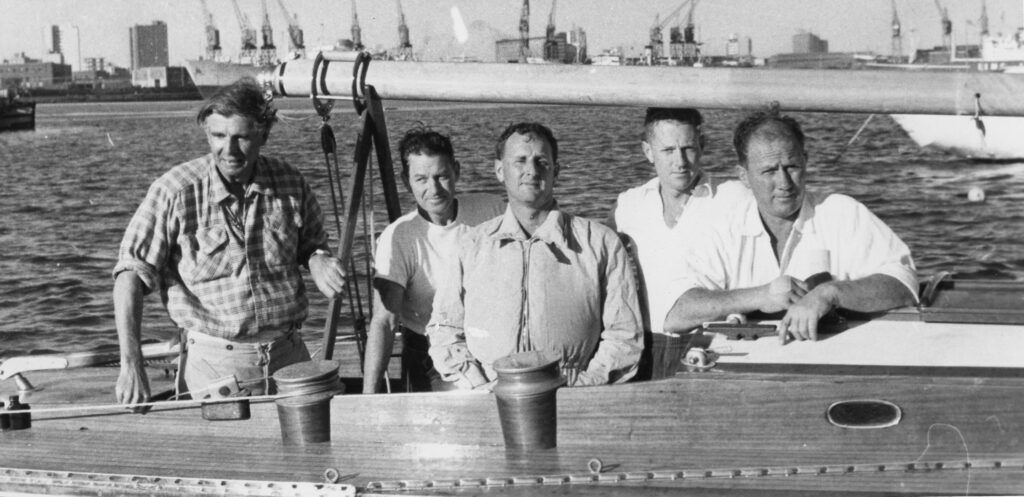
‘Mariquita’’s crew were: Wilfred Hancock (skipper); Cyril Warne; Joe Phillips; Lewis Evans & Trevor Green.
READ “TINTOMARA SNEAKS IN FOR THRILLING LIPTON CUP FINISH” HERE: 1959 06 20 – daily news – tintomara sneaks in – 1959 Lipton Cup – RCYC Archives – 011702 – OCR_Redacted
Impressions by the Winner – Wilfred Hancock
I think all will agree that these races were thoroughly enjoyed by everyone concerned. The weather was beautiful, though the winds on four of the five days were very light. l have the impression that the speed of the boats has improved quite a lot in the past 12 months. This is rather borne out by the fact that the 60 miles covered in the 1958 races took 15 hours 59 minutes with an average speed of 3.75 knots, whereas the 1959 series took 14 hours 46 minutes with an average speed of 4.06 knots.
This included a very exhilarating, though rather alarming, run with spinnakers in 41 minutes at an average speed of 9 knots.
I think the advent of synthetic sails has had something to do with the greater speeds recorded this year.
The visiting crews probably suffered from a disadvantage in that they had not had nearly as much competitive racing in their home ports compared with the Durban yachts, who had been racing every Sunday since February. Competitive racing of this sort is essential to bring yachts and crew up to a high pitch of efficiency, as was borne out in the America s Cup races last year.
One other point I would mention is that I think nearly all competitors would prefer to see the course lengthened somewhat and sailed over two short rounds instead of one long round. This would give scope for greater use of tactics and would also be of more interest to spectators. I believe this matter will be under consideration by the various Yacht Clubs during the coming year.
Comment from SA Yachting magazine
Last year at Port Elizabeth, Wilfrid Hancock achieved the astonishing feat of five wins in a row with the veteran yacht Sunmaid. This time at Durban with a new boat he won four out of five – that is, nine out of the last 10 races. ‘Mariquita’, a Swedish-built Thirty Square Metre keel yacht, had been entered in 12 club races in Durban waters before the Lipton Cup series began.
Wilfrid Hancock said of his team in ‘Mariquita’: “My crew have been with me a long time. They understand my ways, and I understand their ways. “One of them, Trevor Green, has crewed with his skipper for 20 years. Cyril Warne and Joe Phillips played their part in Sunmaid’s great show last year and Lewis Evans was John Sully’s crew at the past Olympic Games in Melbourne.