Sailing Magazine

by Richard Crockett
The use of trackers in yacht races is an absolute must in modern day ocean racing, and this race has for several years now used YB Tracking – the Rolls Royce of trackers.
Sadly though this is not followed up with social media offering info from the boats, wind strengths, directions and changes, or simply any additional news that will allow landlubbers following on their electronic devices anything meaningful that gives some insight as to what’s actually going on out there!
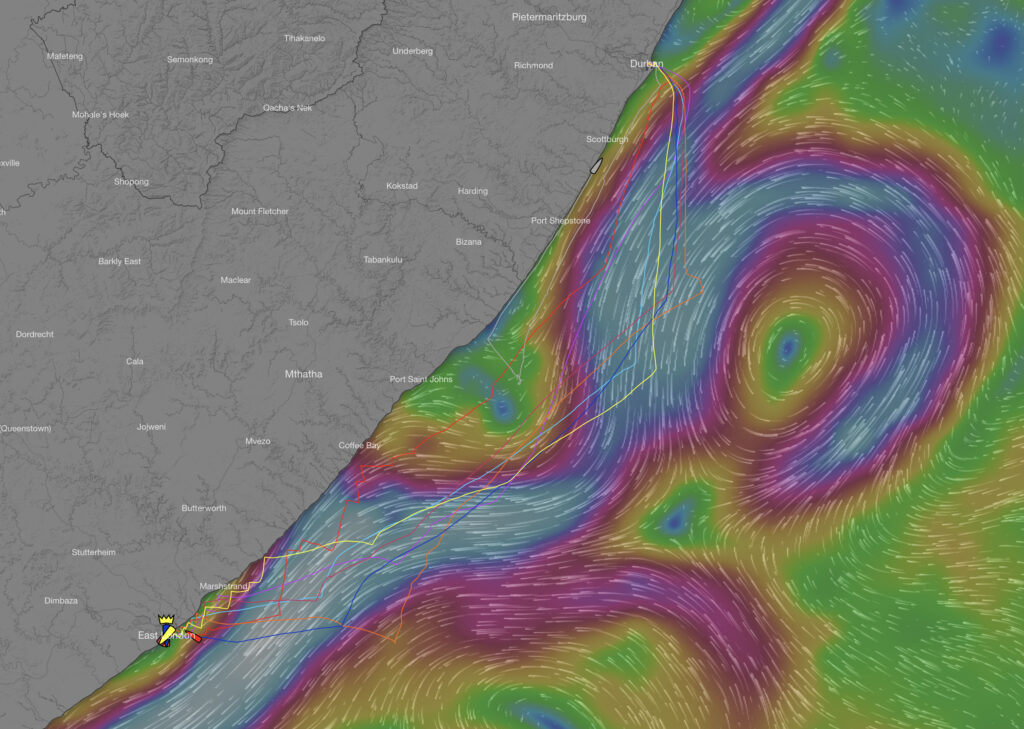
As a landlubber the first thing I noticed after the start was just how much current the fleet had pretty close inshore, and that a dreaded south wester was forecast for the last third or more of the race. It initially looked like it would be one of those races that previous Vasco competitors had wished they had signed up for as there was likely to be more downwind than upwind sailing.
It was the fast southwards flowing Agulhas current that interested me as it was depicted to be running at about 2 knots, and was not difficult to get to. It came as no surprise to see the fleet putting in a 20 nautical mile leg out towards the current after the start. It was a pretty wide track at times, and was doing the classic thing of flowing southwards very close to the coast at Port Shepstone and then moving away from the coast again at Port st Johns. I had the impression that some knew vaguely about the current, but not enough and did not take full advantage of it as they sailed out of it for a while and then back into it again on occasions.
At the same time as the above, ‘Metric 4T’ was about 50nm offshore before she gybed onto a course almost parallel to the coast. In fairness to them, they were the only double-handed entry, so may not have had sufficient time to check the current.
The course of ‘FOMO’ caught my eye early on as she was staying in and maximising her use of the current despite being the furthest boat offshore late on the first day. She too gybed inshore, staying in the current longest, despite sailing out for a while in the area between Port St Johns and Coffee Bay. Her choice of course and tactics struck me as being smart and optimally good, especially as I knew what her skipper Dale Kushner had in mind with this manouevre – which was to get into the beach and out of the current when the westerly hit.
As the sun set on the first night it was close at the head of the fleet between ‘CFM II’, ‘Rocket’ and ‘Regardless 2’.
Once the dreaded south-wester arrived Kushner’s call was sound as he short-tacked parallel to the beach all the way to the finish. By doing this he had flatter water and was able to sail faster than he would have in the current. It’s never an easy decision to make the choice of staying in the current or going inshore. Staying in the current where one has westerly winds against the south flowing current makes conditions quite rough and difficult to sail in. The balance between flatter water inshore and a few knots of push by the current is a conscious decision one has to make – and can be the difference between winning and losing.
‘Metric 4T’ skipped out of the current again to about 50 miles offshore and when only 45nm from the finish. She had to sail quite high to ensure that she was never swept past East London, as did ‘Regardless 2′. Fortunately they both avoided that embarrassment.
At the head of the fleet there was a ding-dong battle between ‘CFM II’ and ‘Rocket’ for line honours. Herbie Karolius had his trusty steed ‘Rocket’ stuck to Nigel MIlln’s transom and he did everything in his power to find a passing lane – which simply never appeared, as just 16 minutes separated them on the finish line, with Milln wearing the winners’ crown, and Herbie runner-up. Both sailed a very good race as there were other boats which could have easily challenged them, but they had a 90 minute buffer on the third finisher ‘Regardless 2′.
Milln has now taken line honours on several occasions in recent years and has been hailed by some as “the Vasco king”. Karolius was looking for his second line honours victory, yet had the satisfaction of knowing he had judged his race well and had come within a hairs-breath of being first home.
The fight for the overall winner on handicap was ultimately contested between Kushner and Milln, although for parts of the race ‘Zing’ wore the leaders’ handicap crown. Kushner took victory by some 40 minutes overall, close for some but enough to give him a deserved victory.
Dale Kushner spoke about his decision to cut the current when almost abeam of Coffee Bay. “We had about 3.1 knots of current at one point for a short while, and went down to between 2.1 and 2.4 knots of current which did not deter me. I knew that it was going to get rough and I wanted to be on the beach to get flatter water and hopefully sail faster than if I was in the current where thing were quite violent. We used the current well” he said, adding that the maximum wind speed they had upwind was about 25 knots.
“Coast hopping to the finish was the prudent thing to do in the circumstances” said Kushner.
Despite being the last boat home, I was impressed that the crew of ‘Spirit of Anna Wardley’ was sailed conservatively and safely by being close to the shore most of the time, and persevering all the way to the finish line. That’s how experience and seamanship is gained.
With just 8 boats in the fleet and one retiring, it’s concerning that four of those are Cape based which means that the home port of the race could only muster four boats. It’s massively costly to sail a yacht 1000nm to a start line and another 800nm home again, so the organisers need to start NOW and recruit new boats for next year as the Cape boats won’t always choose to compete due to the cost. This classic ocean race deserves a good fleet.
Results – ORC
1. FOMO – Dale Kushner
2. CFM II – Nigel Milln
3. Rocket – Herbie Karolius
4. Zing – Ashley Rainer
5. Regardless 2 – Peter Blofield
6. Metric 4T – Dealtry Pickford
7. Spirit of Anna Wardley – B Makhanya
RTD. Zephyr – E Klinkert
ORC – double handed
1. Metric 4T – Dealtry Pickford